Dan Rifkin
Defending JacobDan Rifkin, the father of Benjamin Rifkin, is a bereaved parent whose need for answers repeatedly intersects with the investigation and trial of Jacob Barber. His appearances trace grief’s movement from private questioning to public estrangement and, finally, an attempted attack: the legal dismissal of Jacob’s case ends the prosecution but does not change Dan’s apparent belief that Jacob killed his son.
Identity and First Encounters
When Andrew Barber encounters Dan in a dim bedroom, Dan sits alone in a wing chair beneath a brass floor lamp. Andrew notices his small, trim appearance, carefully arranged hair, dark suit, and a two-inch tear in the lapel. Dan’s sunken eyes and bluish circles register the physical strain of grief; the narrator, himself a father and participant in the case, describes the scene through a mixture of sympathy and uneasy observation.
Dan’s first questions are not requests for forensic particulars. He tells Andrew that he cannot get past the question of why the killer did it, distinguishing that larger demand for meaning from the evidence and court procedures they have discussed before. He presents himself as rational and says he has questions beyond the case details. The distinction matters: the investigation can assemble evidence, but it cannot automatically answer the human question Dan is asking.
Grief and the Demand for Resolution
Dan tells Andrew that uncertainty is draining and that the case’s resolution would help him and his family. He imagines relief in knowing that the perpetrator has been identified and imprisoned, and says he has faith Andrew will achieve that outcome. His appeal combines trust with pressure: he insists he is not doubting Andrew, while making clear that he and his wife need closure.
Andrew understands the force of Dan’s grief but also feels the strain of being asked to make legal resolution carry the work of emotional repair. The case is not merely an abstract prosecution to Dan; its unresolved status keeps the loss active. Yet the confidence he places in Andrew depends on an outcome that the eventual course of the case cannot provide in the form Dan wants.
At Cold Spring Park, Dan appears in Andrew’s lasting image of him as a small figure crossing an empty expanse of grass, head bowed and hands thrust into his coat pockets. The vast playing fields make his isolation visible without making it less particular: Andrew goes out to meet him, and the two men slowly approach one another across the open ground. The image gives physical form to the distance between the bereaved father and the prosecutor, even as they move toward a conversation.
Distrust and the Rifkins’ Encounter with the Barbers
By a later encounter, Dan’s appearance has changed: his eye bags have darkened and his olive skin has grown grayish. He removes and carefully folds his sunglasses before telling Andrew that he thinks he is false. He has also heard that Andrew may be taken off the case and says he wants another district attorney. Dan does not reveal who told him about the possible change. His demand marks a break in the trust he had earlier professed, though the available account does not establish exactly what prompted it.
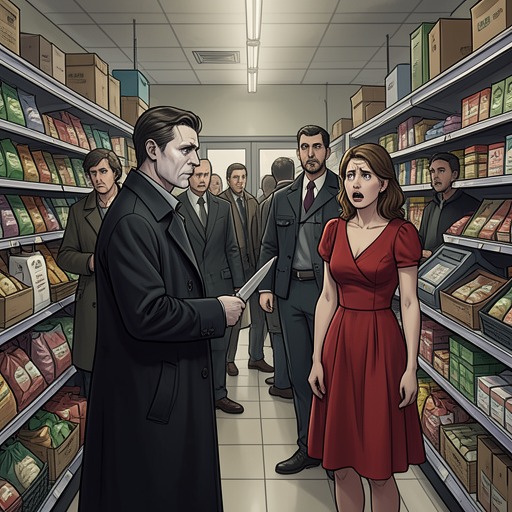
The Rifkins and the Barbers meet unexpectedly in a Whole Foods checkout line. Dan is dressed in pressed khaki shorts, a tucked-in polo shirt, and loafers, with his sunglasses resting on his head; Andrew observes the contrast between the informality of the clothes and Dan’s naturally formal bearing. Dan initially does not see the family beside him. When he and Joan do, the encounter becomes a silent confrontation: Dan barely moves, while Joan glares at the Barbers. Andrew understands the scene through the unequal arithmetic of the two families—three people present, two in the Rifkin family—and through the absence of the son each family’s position in the case makes impossible to ignore.
Laurie approaches Joan with her palms open, a gesture that might be an offer of contact or an admission that she does not know what to say. Joan folds her arms. Dan raises an arm slightly, appearing ready to hold Laurie back if needed, and Joan spits toward Laurie as a sudden expression of hostility. Andrew takes Laurie’s hand and leads her away, apologizing as they pass the other shoppers. The family leaves without its groceries and returns to the relative anonymity of the parking lot. The confrontation makes the investigation’s human divide immediate: the Barbers’ continued presence together is inseparable from the Rifkins’ loss.
The Attempted Attack and Aftermath
After Jacob’s case is dismissed, the Barber family reaches its car. Dan approaches in a tan trench coat decorated with numerous buttons, pockets, and epaulettes; Father O’Leary follows a few feet behind. The Barbers initially read Dan’s approach as a possible welcome back after the painful proceedings, but his expression is hard. He takes an ordinary kitchen knife from a deep coat pocket. Andrew recognizes it as the same make as a steak knife in his own household set, an unsettling domestic resemblance that briefly complicates his understanding of what is happening.
Father O’Leary intervenes before Dan reaches the family, disarms him, and holds him against the car. When released, Dan has tears in his eyes and looks helpless. Andrew’s account says Dan apparently still believes Jacob killed Benjamin, but cannot act on that conviction. Dan then staggers away; the narrative does not describe what happens to him afterward.
The episode is a violent culmination of the grief and antagonism threaded through Dan’s earlier appearances, not a resolution of either. Jacob’s case has ended in dismissal, but the family’s release from prosecution does not bring reconciliation with the Rifkins. Dan’s final appearance leaves the central uncertainty intact: the legal outcome has changed, while his belief and the loss that shaped it remain.